

See how engineers debug,before you hire them.

Each candidate gets a real broken Linux server. Every command, file edit and fix is recorded. Review hours of investigation in five minutes.

Supported stacks
Go Python PHP with more to come
why bisect

Coding screens stopped predicting hires. Operational skill is what's left.

Writing code is becoming commoditised. The skill that separates a junior from a senior engineer is the ability to investigate broken systems and orchestrate fixes across a real stack. That's the signal Bisect captures.

01 / problem

Live pairing burns engineering hours.

Forty five minutes per candidate, per interviewer, with inconsistent signal. Senior engineers carry the load and burn out on it.

bisect

Async sessions. Review a recorded replay in five minutes, with event markers, a session summary and a weak / acceptable / neutral / strong verdict.
02 / problem

Code screens are gameable, and now AI-solved.

HackerRank-style assessments measure pattern recall in a stateless editor. Modern AI coding assistants solve most of them out of the box. The signal is gone.

bisect

A real broken stack. The candidate has to investigate, hypothesise and verify. There's no prior solution to memorise or paste in.

03 / problem

Behavioural questions are unfalsifiable.

"Tell me about a time you debugged something" rewards storytelling. You learn nothing about how the candidate actually moves through a system.

bisect

Watch them do it. Every command, every file open, every fix. The replay is the evidence.

capabilities

Real environments. A timeline you can actually read.

Each candidate runs in their own isolated Linux server with a full production-style stack. Terminal I/O and file changes are captured server-side, so what you see in the replay is what actually happened.

01 / replay

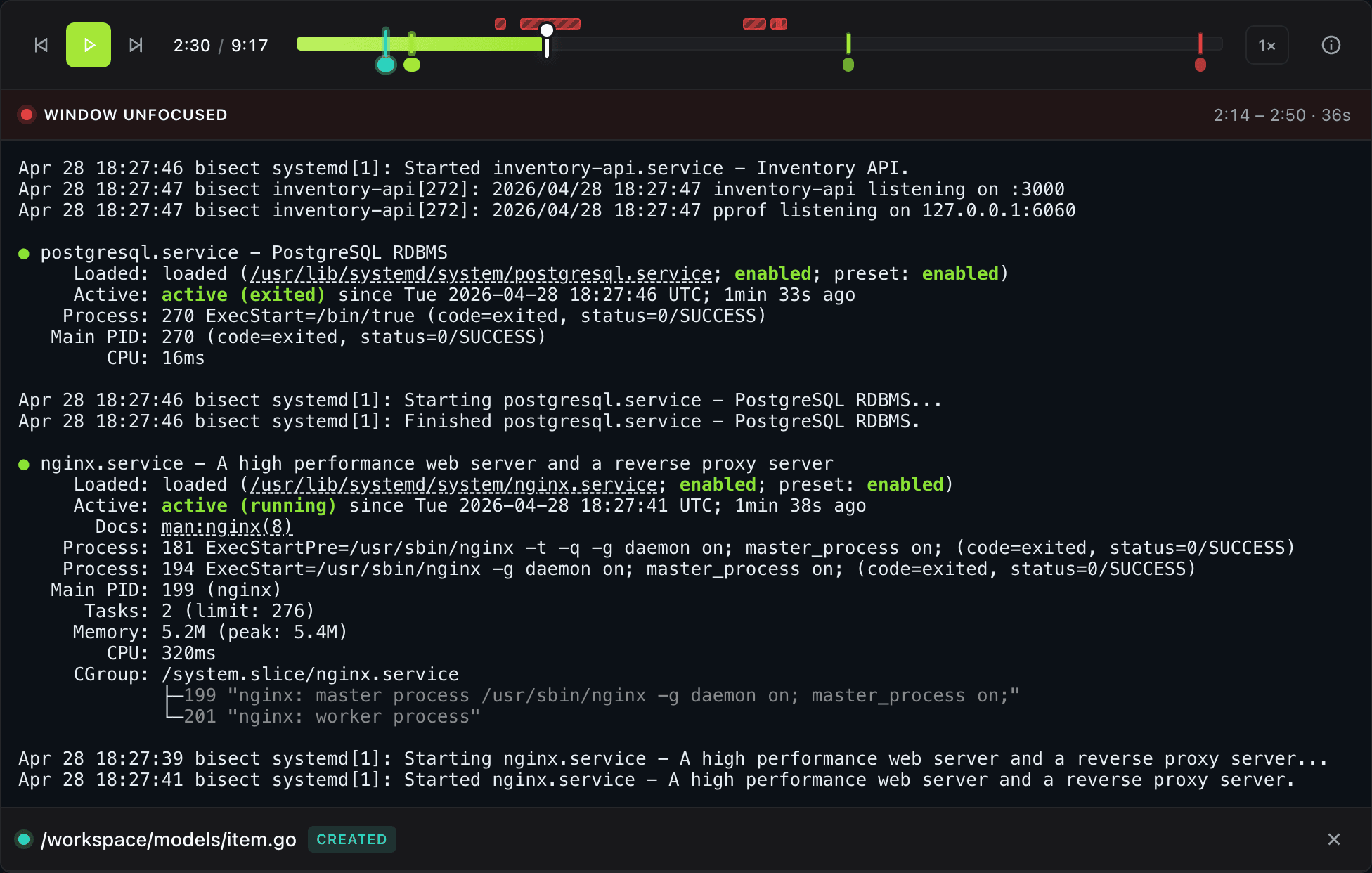
The investigation, played back.

Every keystroke and file change is recorded server-side. Scrub through the session, speed it up, jump straight to the moment the candidate first opened the logs or restarted the service.

  • Synchronised terminal and file diff view
  • Variable playback speed
  • Captured exactly as it happened, not as it was reported
Bisect replay timeline
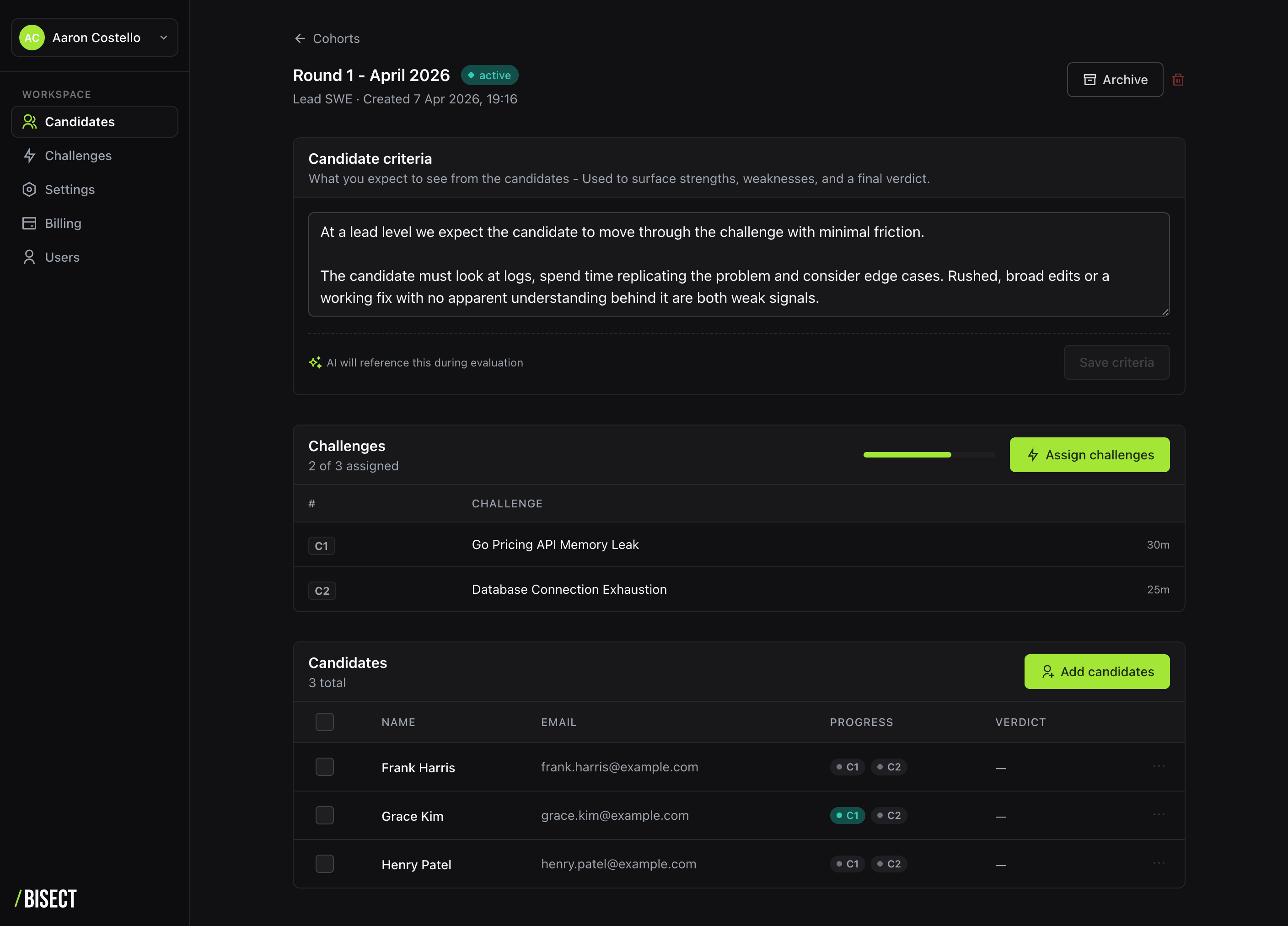
Bisect cohort dashboard
02 / cohorts

A single dashboard for the funnel.

Group candidates by role or pipeline stage. Send magic-link invitations in bulk and watch progress move from invited to in-progress to completed without chasing emails.

  • Bulk import and magic-link invites
  • Per-challenge progress at a glance
  • Reviewer roles and access control
03 / challenges

Real broken stacks, sized to the role.

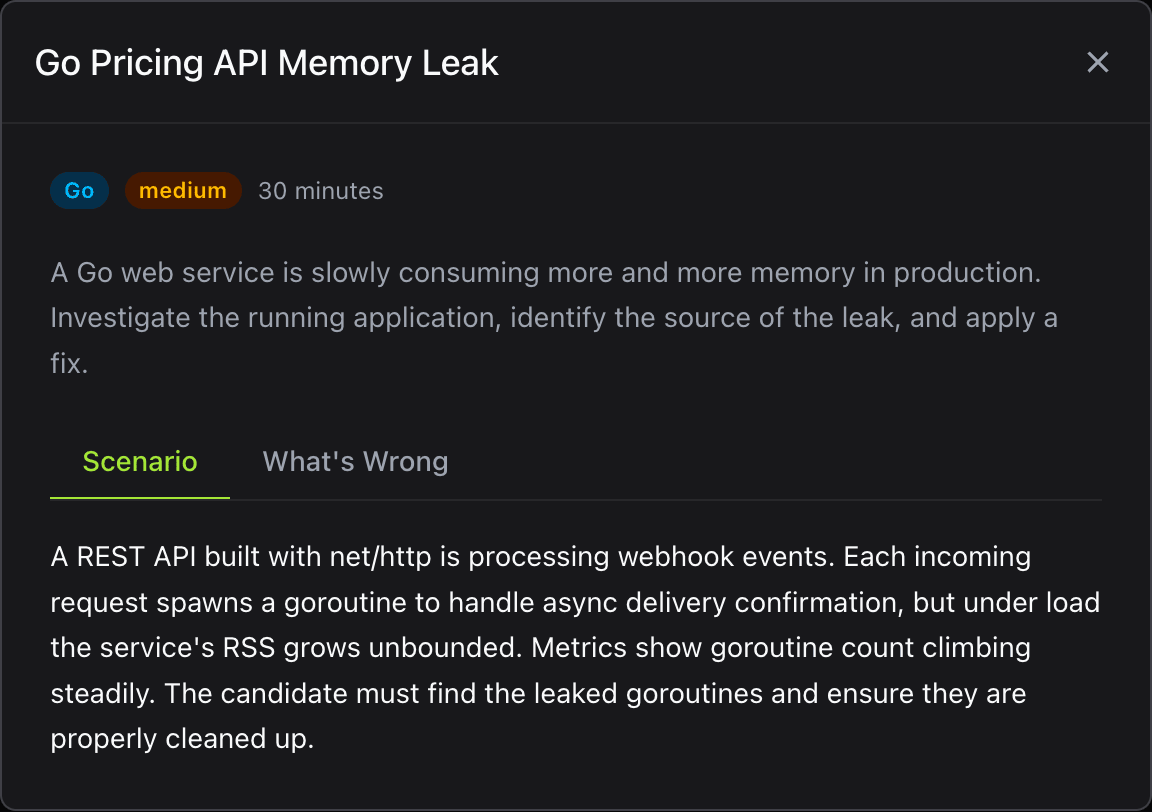
Pick a challenge by language and seniority. Junior scenarios focus on core methodology — reading logs, isolating a failing service. Senior scenarios chain multiple services together with misleading symptoms.

  • Go, Python and PHP with full surrounding stacks
  • Junior, Mid and Senior tiers
  • Library expands and rotates so scenarios stay fresh
Bisect challenge library
Real environments
Each candidate runs in their own isolated Linux server with a full production-style stack. Real services, real process supervisor, real network stack.
Async sessions
Candidates work when they are sharp. No live observation, no scheduling overhead, no senior engineer pulled out of their day.
Scoring rubrics
Per-challenge rubric items keep reviewers consistent across cohorts and roles. Did they read the logs? Did they verify the fix?
Rotating challenge set
Challenges are parameterised and rotated over time, so prior exposure doesn't shortcut the investigation.
flow

Three steps from invite to decision.

Bisect is built to be self-serve. No demo calls, no procurement, no infrastructure on your side.

  1. 1
    Pick a challenge, send an invite.

    Filter by stack and seniority. Generate a unique link. The candidate gets an email and a clear briefing.

  2. 2
    They debug a real broken system.

    Browser-based terminal, editor and file tree, backed by a sandboxed Linux environment. Every action is captured server-side as it happens.

  3. 3
    Review the replay in five minutes.

    Skim the timeline, jump to event markers, read the rubric. Make a hire decision with the actual evidence in front of you.

pricing

Two plans. No sales call.

Start with a 14 day trial. Cancel any time, your replays stay accessible.

starter
$49.99 / month

For small teams running a handful of assessments a month.

  • 2 active cohorts
  • 25 candidate sessions per month
  • Junior and Mid tier challenges
  • Full replay timeline and scoring rubrics
  • Email support
Start with Starter
recommended
pro
$99.99 / month

For teams hiring at volume across stacks and seniority levels.

  • 10 active cohorts
  • 100 candidate sessions per month
  • All challenges, including Senior tier
  • Team calibration benchmarks
  • Share results externally via link
  • Priority support and challenge requests

Need more than 100 sessions a month? Talk to us.

Stop guessing who can debug.

Run your first assessment in under five minutes. The trial includes one free senior-tier challenge for your team to try first.